

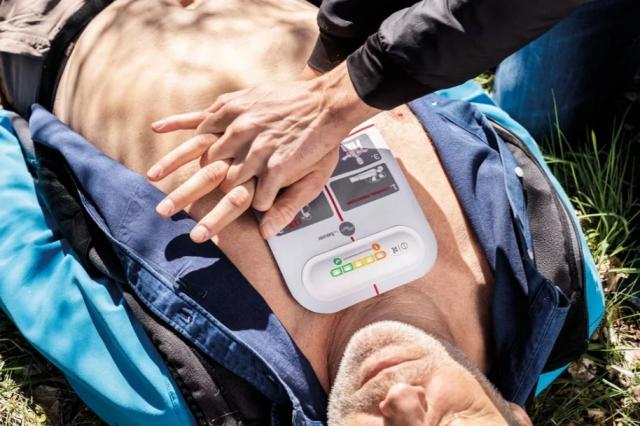
General preventives
The Lifepad reanimatie is intended for single use only and is thus not suitable for exercise After a single use and the associated ending of the circuit through pulling the battery strip, the supplied battery is discharged, meaning that it can no longer be assured that the product can be used again at a later time.
Likewise, the product can not be used on different people for aseptic reasons, as it can not be disinfected or gutted. Cover the LifePad ® against impacts, humidity, dust, chemicals, strong temperature oscillations, direct sun, water, beach and sources of heat that are too close to it( ranges or heaters), as faultless functionality of the LifePad ® can no longer be guaranteed later.
Under no circumstances should you open or repair the Lifepad reanimatie, as faultless functionality can no longer be guaranteed later and you may admit an electric shock. The LifePad ® can not be maintained and/ or calibrated.
Don't use fresh corridors that aren't recommended by the manufacturer or offered as accessories.
Still, you must replace it with a new LifePad ®, If you see or suspect damage to the LifePad ®. The LifePad ® is defended against splashes. Norway submerged the LifePad ® in water.
Willed Use
Use the LifePad ® for the purpose it was developed for only and in the manner specified in these instructions for use.
Intended use
The LifePad motivates and supports first-aids in cardiopulmonary reanimation( CPR) of individuals over 12 times of age after an unforeseen cardiac arrest( SCA) through an aural and visual feedback system to estimate the condensing performed. The LifePad ® is intended for single use only and mustn't be used multiple times under any circumstances.
Intended druggies
The Lifepad reanimatie is intended for use by grown-ups and adolescents over the age of 12 and has been especially designed for use by lay persons. Thus, no specific knowledge or professional capability is needed to use the LifePad ®.
Clinical benefit
The Lifepad reanimatie isn't only intended to motivate further people to give first aid, but also to support inexperienced first-aiders in performing cardiopulmonary reanimation.
Suggestions
The LifePad should be used once the first- Aider has linked that the case is passing a cardiac arrest.
Contraindications
Don't use the Lifepad reanimatie if the case has suffered an obviously fatal injury.
Don't use the LifePad ® if you're sure that the case is breathing typically – indeed if they aren't responding.
Don't use the LifePad ® on people under the age of 12.
WARNINGS AND SAFETY NOTES
General warnings
Indeed if reanimation is initiated incontinently, this doesn't guarantee that the case will survive, indeed if it's performed optimally. In some cases, the beginning problem causing the cardiac arrest means that the case won't survive, despite the stylish care.
Cases with serious injuries shouldn't be moved. Without using the LifePad ®, the layper- son( stoner) should also not move the case on another ground.
Cardiac massage with and without LifePad ® is less effective for people lying on soft ground.
Rib fractures and other injuries are common, but respectable consequences of reanimation given that the volition is death due to cardiac arrest. After reanimation, all cases should be assessed for injuries caused during reanimation.
In addition to the below- mentioned consequences, skin scrapes, bruises and injuries on the casket can frequently do during reanimation. Despite this, don't stop performing the condensing, but continue CPR until professional help arrives.
- Rib fractures
- Sternum fractures
- Atelectasis
- Collapse of the lung
- Hemothorax
- Pleural effusion
- Infection of the lung
Norway delayed treatment to find out the exact age of the case.
Check the LifePad ® face for integrity before starting reanimation to help sharp edges or dangerous areas.
In the event of a disfigurement, perform the cardiac massage without the backing of the LifePad ®. Don't delay or intrude the launch of first aid measures to amend the disfigurement. Continue to follow the instructions for carrying out CPR illustrated by the pictograms. Indeed if the device fails, continue cardiac massage at a pressure frequency of at least 100 per nanosecond until clear signs of life are formerly again distinguishable or the exigency croaker takes over. The pressure must be high enough to achieve a pressure depth on the casket of 50 mm to 60 mm.
The Lifepad reanimatie is only intended to support the emergency services( which have been advised) and can not fully replace them.
- The LifePad ® isn't intended to replace possible training measures in the field of first aid. previous knowledge is a benefit, but not absolutely necessary for use.
- Keep packaging material down from children. There's a threat of suffocation.
- The LifePad ® isn't a toy. Store the LifePad ® out of the reach of children.
- To reduce the pitfalls associated with strong electromagnetic fields, similar to device failure, don't use the LifePad ® near strong high- frequency signals or movable and/ or mobile HF bias.
- The use of accessories, transformers and lines other than those intended for the LifePad ® may affect increased HF emigrations or dropped impunity of the LifePad ®.
- To avoid unnecessarily syncopating the service life of the LifePad ®, only switch it on when treating a case.
- still, the battery life can no longer be guaranteed, If you pull out the battery strip precociously.
- If the LifePad ® is used in combination with a defibrillator, follow the safety instructions of the defibrillator.
- Please report any unanticipated operation or events to the manufacturer.
- Device not suitable for use in presence of anesthetic fusions ignitable with air, oxy- word or nitrogen protoxide.
- The device doesn't have an ECG function.