

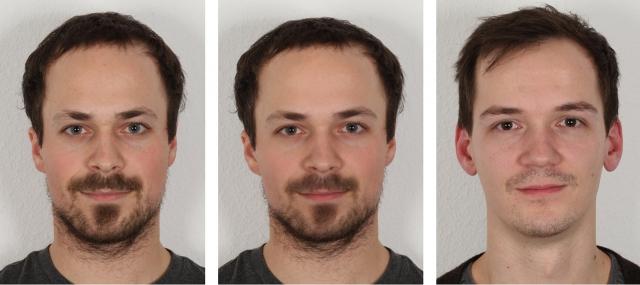
Originally developed as a design technology, face morphing has now become a tool that, when misused, poses serious security risks. Fraudsters have learned to exploit morphing techniques to manipulate face recognition and identity verification systems, bypass security measures, and commit fraud.
This article explores the concept of face morphing, its applications—both positive and negative—the different types of morphing, and the security challenges it presents. We will also discuss why detecting morphs is difficult and examine modern approaches to preventing morphing attacks.
What is Face Morphing?
Face morphing is a digital image synthesis technique that blends two or more facial images to create a new, synthetic face that resembles both individuals. This process is widely used in entertainment, such as movies and face-swapping applications.
A typical morphing sequence results in a composite image that retains facial features from all contributing faces, making it difficult to distinguish between real and morphed images. This is why fraudsters exploit morphing in identity documents, allowing multiple individuals to pass identity checks using the same document.
The Uses of Face Morphing: Positive and Negative
While face morphing has legitimate and creative applications, it also presents risks when misused.
Positive Uses:
- Entertainment & Art – Morphing is widely used in movies, animation, and digital art.
- Social Media & Apps – Face-swapping apps allow users to create fun or artistic images.
- Medical Research – Used in studies on aging and genetic facial features.
Negative Uses:
- Identity Fraud – Criminals use morphed images to forge identity documents.
- Deepfake Manipulation – Morphing can be integrated into deepfake technology to spread misinformation or deceive individuals.
- Bypassing Biometric Systems – Some morphing techniques can trick facial recognition systems used in border control, banking, and other identity verification services.
Types of Face Morphing
Face morphing can be categorized based on the approach and tools used:
- Basic Morphing – Uses simple algorithms to blend two images, often producing visible artifacts.
- AI-Assisted Morphing – Utilizes deep learning to generate highly realistic morphed faces.
- Manual Morphing – A combination of digital editing and manual retouching to create near-perfect morphs.
- Real-Time Morphing – Used in AR/VR applications for live face blending.
How Does Face Morphing Work?
Facial morphing follows a structured process involving three main steps:
- Landmark Identification – Key facial points (e.g., eyes, nose, mouth) are detected to create a coordinate system.
- Geometry Warping – Facial landmarks are repositioned to generate an intermediate shape.
- Texture & Color Blending – The final image is created by merging textures and colors from the source images, often smoothing out details for a seamless transition.
Is Face Morphing a Security Threat?
Yes, face morphing poses a serious security threat, particularly in identity verification systems. Fraudsters use morphing techniques to manipulate passports, ID cards, and other forms of identification.
A high-profile case in 2018 demonstrated this risk when a morphed photo of an activist and a European official was successfully used to obtain a legitimate passport. This case underscores the threat of fraudulent document issuance and unauthorized border crossings.
Morphed images compromise the integrity of biometric systems by allowing multiple individuals to authenticate under a single identity. This has serious implications for financial fraud, illegal immigration, and national security.
Why is Face Morphing Difficult to Detect?
Detecting morphed images presents significant challenges:
- High-Quality Morphs Are Indistinguishable – Sophisticated morphs closely resemble real people, making them difficult to detect with the human eye.
- Automated Systems Are Not Foolproof – Even advanced biometric systems struggle to differentiate morphs from genuine images.
- Human Examiners Are Prone to Error – Studies show that even trained professionals have difficulty identifying morphed images.
Morph Detection Challenges in AI Systems
The National Institute of Standards and Technology (NIST) has tested facial recognition algorithms against morphed images, revealing high error rates, particularly for well-crafted morphs. This underscores the need for improved detection mechanisms.
How to Prevent Morphing Attacks?
The effectiveness of morphing attack prevention depends on early detection and intervention. Below are key strategies to counter morph-based fraud:
1. Live Enrollment for Identity Documents
- On-Site Biometric Capture – The most secure approach is requiring individuals to have their photos taken at designated enrollment centers.
- Secure Remote Enrollment – Countries like the UK and Finland have adopted solutions where photo submission is monitored and authenticated to prevent morphing attempts.
2. Enhancing Border Control and Identity Verification
- Forensic Document Examination – Specialized tools, such as Regula's forensic devices, can detect alterations in identity documents.
- Chip-Based Authentication – Comparing the printed photo with the biometric image stored in the RFID chip of passports provides an additional verification layer.
- Morph Detection Algorithms – AI-powered morph detection tools can help identify synthetic faces before they are used for fraud.
3. Equipping Checkpoints with Proper Devices
- Frontline Defense – Compact forensic tools like the Regula 4325 allow border officers to detect anomalies such as glossiness or microrelief inconsistencies in printed photos.
- Advanced Lab Verification – High-resolution forensic systems like the Regula 4308 analyze texture, layers, and ink absorption to uncover subtle morphing traces.
Conclusion
Face morphing presents a significant challenge to identity verification and security systems. Fraudsters exploit morphing techniques to create convincing fake identities, which can have serious consequences for financial institutions, border control, and law enforcement agencies.
However, with the right combination of live enrollment processes, forensic tools, biometric verification, and AI-driven morph detection, organizations can effectively mitigate this threat. As identity fraud techniques continue to evolve, security solutions must advance in parallel. Regula's expertise in document and biometric verification provides businesses and authorities with the tools necessary to stay ahead of emerging threats.